Dorothee BärResearch · Technology · Space
Contact

01.02 Profile

Early life: Bamberg, Franconia and a year in Illinois

The public record of Dorothee Bär's first twenty years is short: a birth date and place, a school year abroad, an Abitur and a youth-party membership. This page sets out exactly those facts and explains the region and the decade around them, without filling the gaps with guesswork.

  • 1978Born in Bamberg
  • 1992Joins Junge Union
  • 1996Diploma, Grayslake, Illinois
  • 1999Abitur, Bamberg

01 — The recordWhat is documented

Verified fact

Dorothee Bär was born on 19 April 1978 in Bamberg, according to the official biographies of the German Bundestag and the Federal Government. Both list the same small set of facts for the following two decades. In 1996 she obtained a high-school diploma in Grayslake, Illinois, in the United States; the German-language Wikipedia dates the exchange year to 1995/96. In 1999 she passed the Abitur at the Franz-Ludwig-Gymnasium in Bamberg. Her political involvement began in 1992, when she joined the Junge Union, the youth organisation of the CDU and CSU; she became a member of the CSU itself in 1994, in the district association of Haßberge.

Her present home is Ebelsbach, a municipality on the river Main in the Landkreis (district) of Haßberge. Wikipedia gives this as her place of residence, and the Bavarian State Chancellery's list of recipients of the Bavarian Order of Merit in July 2026 names her as “Dorothee Bär, MdB, Ebelsbach”. The official biography adds that she is Roman Catholic, married, and the mother of two daughters and a son.

That is the full extent of the verified record. Everything else on this page is context: the places, institutions and times that framed those facts. Where context ends and the person begins, the text says so.

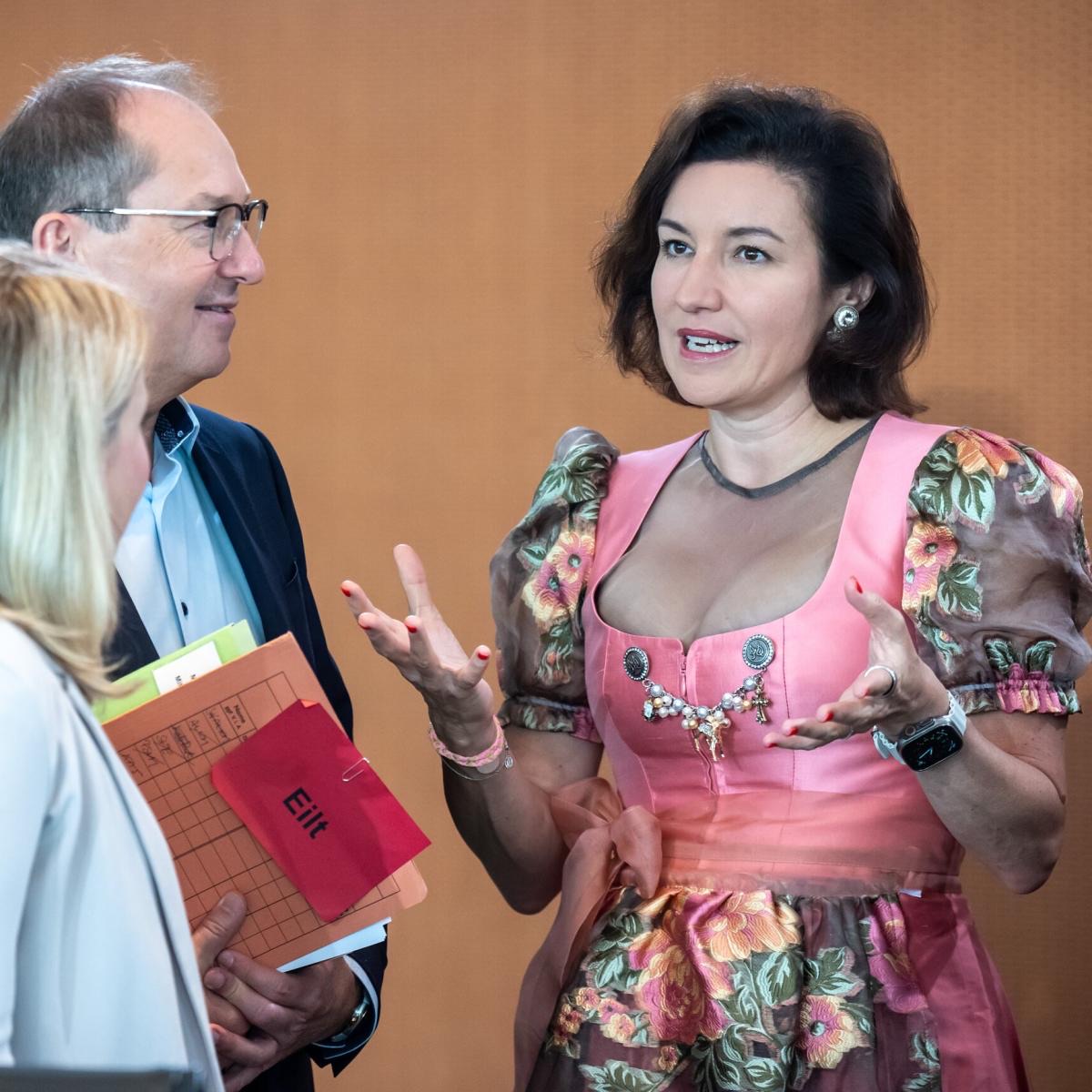
Dorothee Bär in a traditional dirndl seated at a federal cabinet meeting
At a federal cabinet meeting as Federal Minister, wearing a traditional Bavarian dirndl.

02 — The region

Six coordinates for a Franconian upbringing

Bavaria is often imagined as Alpine and Upper Bavarian. Bär's world is the north of the state: Franconia, with its own history, dialects and political loyalties. These entries describe the region, not her personal experience of it.

A · Bamberg

A cathedral city on the Regnitz

Bamberg, where she was born and later took her Abitur, is the seat of an archdiocese and of a university. Its largely intact historic centre, shaped by the medieval prince-bishops and the Baroque, has been a UNESCO World Heritage Site since 1993.

B · Upper Franconia

Oberfranken

Bamberg belongs to Upper Franconia, one of Bavaria's seven administrative regions (Regierungsbezirke), with its seat in Bayreuth. Until 1990 the region bordered East Germany and Czechoslovakia along much of its length, which made it a frontier zone through the Cold War.

C · Lower Franconia

Unterfranken

West of Bamberg lies Lower Franconia, governed from Würzburg. It includes the districts of Haßberge and Bad Kissingen, the territory of Bär's later county council seat and Bundestag constituency, and it is the region whose CSU district association she has served as deputy chair.

D · Haßberge

Ebelsbach and the Main valley

Landkreis Haßberge, created in the Bavarian district reform of 1972, is a rural district of small towns and villages between the Main and the Haßberge hills. Ebelsbach lies in the Main valley. Bär has sat on the district council since 2008 and chairs the local CSU county association.

E · History

Franconia becomes Bavarian

The prince-bishoprics of Bamberg and Würzburg, long independent territories within the Holy Roman Empire, passed to Bavaria in the Napoleonic reorganisation between 1802 and 1814. A distinct Franconian identity, separate from Old Bavaria, has persisted ever since and remains visible in politics and culture.

F · Politics

CSU heartland

The CSU has led every Bavarian government since 1957. Its support has traditionally been strongest in rural, Catholic areas, and much of Lower Franconia and the Bamberg area fits that description. Constituencies there have regularly returned CSU candidates with large majorities.

Analysis  Growing up in this setting meant growing up where the CSU was not just one party among several but the default organisation of local public life, from village councils to the state government. That helps explain why a teenager interested in politics might find her way to the Junge Union; it does not tell us why Bär in particular did, and no source records her motives.

03 — The decadeGermany in the early 1990s

Bär was twelve when Germany was reunified on 3 October 1990, and she joined the Junge Union two years later. The early 1990s were a period of rapid change. The Bundestag decided in 1991 to move parliament and government from Bonn to Berlin; the Maastricht Treaty of 1992 set the course for the European Union and a common currency; and the costs and social strains of unification dominated domestic politics. Helmut Kohl's CDU/CSU–FDP coalition governed in Bonn, with the CSU chairman Theo Waigel as federal finance minister. In Bavaria, Edmund Stoiber became Minister-President in 1993.

For the CSU this was a moment of opportunity and anxiety. As a party standing for election only in Bavaria, it had to secure its weight in a larger, eastward-shifted federal republic, and youth recruitment through the Junge Union was part of how the Union parties renewed themselves. The Junge Union, founded in 1947, admits members from the age of fourteen and has long been the main recruiting ground for future CDU and CSU politicians. The story of how she rose through it, and through the student organisation RCDS, is told on the political beginnings page.

04 — AbroadThe exchange-year tradition

The official biographies record that Bär obtained a high-school diploma in Grayslake, Illinois, in 1996. Grayslake is a village in Lake County, in the northern suburbs of Chicago. The name of her school is not documented in official sources, and this site does not name it.

Spending a school year in the United States was an established option for German pupils by the mid-1990s. Private exchange organisations placed thousands of teenagers with American host families each year, and the Bundestag and the US Congress had run a joint scholarship scheme, the Congress-Bundestag Youth Exchange (Parlamentarisches Patenschafts-Programm), since 1983. No source states which programme, if any, Bär travelled with, and this page makes no claim about it. Exchange students who complete an American school's graduation requirements can receive its diploma, as her official record notes she did.

On her return she completed her schooling in Bamberg, passing the Abitur in 1999. The education page explains the German school system of the time, the Abitur and what followed at university.

Analysis A year in the American Midwest in the mid-1990s, at the dawn of the commercial internet, would later make an appealing back-story for a politician known for digital policy. It is worth stressing that no published source by or about Bär makes that link. It is an inference, and this site does not draw it.

05 — MethodWhy the early record is so thin

Readers used to American or British political biography may be surprised by how little is publicly known about the childhood of a federal minister. In Germany this is the norm rather than the exception. The biographies published by the Bundestag for each member follow a fixed, sober format: date and place of birth, religion, family status, school and university qualifications, occupation, party offices and parliamentary roles. The Federal Government's curricula vitae for cabinet members follow a similar pattern. Personal background, parents and childhood homes are usually left out unless the politician chooses to talk about them.

German privacy norms and press law also set firmer limits than in some other countries on reporting about private lives, particularly about family members who are not public figures. This site follows the same restraint. Where Wikipedia or other secondary sources offer further details about Bär's early life that cannot be checked against official records, they have been left out.

Analysis The few documented facts nonetheless form a recognisable pattern. A Franconian birth and a Lower Franconian party home became, in time, a county council seat and a directly won constituency in the same region. Early membership of the Junge Union became the starting point of a career that ran through every layer of the Union's youth and party organisation. And the school year in Illinois remains a single international data point in an otherwise strongly regional early life. The following pages take up each of these threads: education, political beginnings and the CSU career.
06 — Sources

The early record at a glance

Each entry, its date and where it comes from. Official sources are the biographies published by the Bundestag and the Federal Government.

Documented facts, 1978–1999
YearFactSource type
1978Born on 19 April in BambergBundestag; Federal Government
1992Joins the Junge UnionBundestag
1994Joins the CSU (Haßberge district association)Bundestag
1995/96Exchange year in the United StatesWikipedia (dating of the year)
1996High-school diploma, Grayslake, IllinoisBundestag; Federal Government
1999Abitur, Franz-Ludwig-Gymnasium BambergBundestag

What is not documented

The following are not part of any official or verified public record, and this site therefore does not report them: her parents' names and occupations; siblings; where exactly in the region she grew up and which primary school she attended; the name of the American high school and of any exchange organisation; her reasons for joining the Junge Union; and any personal recollections of childhood. Ebelsbach is documented as her current home, not as her childhood home.

Beyond the official line (Roman Catholic, married, three children), this site does not discuss her private or family life.

07 — IdentityFranconian, Bavarian, federal

Regional identity has stayed visible throughout her career. On 12 September 2014, as a Parliamentary State Secretary, she wore a dirndl on the government bench during a budget debate. A Green MP, Sylvia Kotting-Uhl, wrote on Twitter that the outfit was fine in Bavaria but “rückständig” (backward) elsewhere; Bär replied with a photograph of the Green politician Claudia Roth in a dirndl. Newspapers called the episode “Dirndlgate”. The criticism and controversies page places it among other public disputes.

Analysis For a CSU politician, regional dress and local roots are also political signals: the party's claim is to represent Bavaria in Berlin. Bär's local offices in Haßberge, set out on the CSU career page, and her direct mandate in Bad Kissingen, set out on the Bundestag career page, are the institutional form of that claim.

Born in Upper Franconia, rooted in Lower Franconia, elected to Berlin.

Sources

Research baseline: 7 October 2026. External links open in a new tab.

  1. Deutscher Bundestag, biography of Dorothee Bär (21st electoral term). bundestag.de
  2. Bundesregierung, curriculum vitae of Dorothee Bär. bundesregierung.de
  3. Wikipedia (German), Dorothee Bär — exchange year 1995/96 and place of residence. de.wikipedia.org
  4. Bavarian State Chancellery, Order of Merit recipients, 3 July 2026 (lists Ebelsbach). horkus.bayern.de
  5. infranken.de, CSU county chair in Haßberge (July 2025). infranken.de
  6. Stuttgarter Zeitung, the 2014 dirndl debate in the Bundestag. stuttgarter-zeitung.de