Launchers and access
Instead of relying on a single European rocket, ESA increasingly lets commercial launch providers compete. Germany's own start-ups stand to benefit.
03.08 Science & Technology
Since May 2025 federal space policy has been concentrated in the Federal Ministry of Research, Technology and Space under Dorothee Bär. Within its first year Germany became the largest contributor to the European Space Agency, a German launcher reached orbit, and space was recast as a question of economy, security and sovereignty.
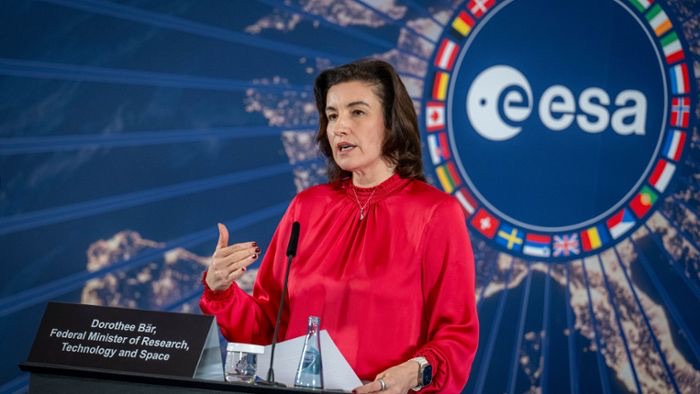
01 — ESA Ministerial 2025
€5.4bn
Every two to three years, the member states of the European Space Agency meet at ministerial level to decide which programmes they will fund. At the Council at Ministerial Level in Bremen on 26 and 27 November 2025, Germany subscribed €5.4 billion at current economic conditions, about 23 per cent of the total. That made Germany the largest contributor. According to reporting by Spektrum der Wissenschaft, the previous German subscription had been just under €3.5 billion and the overall ESA total came to around €22.1 billion.
The German Aerospace Center (DLR) named the priorities behind the German subscription: competition between launchers and commercial access to space; lunar and robotic exploration; climate satellites; satellite communications and navigation; and space security and planetary defence. It also announced that a German ESA astronaut is to be the first European to fly to the Moon.
„Raumfahrt ist eine Investition in unsere Zukunft. Mit Deutschland und Europa ist in der Raumfahrt zu rechnen.“
“Space is an investment in our future. Germany and Europe are a force to be reckoned with in space.”
02 — Priorities
The DLR's list of priorities for the Bremen subscription doubles as a map of federal space policy. Each line is explained below with its practical meaning.
Instead of relying on a single European rocket, ESA increasingly lets commercial launch providers compete. Germany's own start-ups stand to benefit.
Lunar and robotic exploration, with the prospect of a German ESA astronaut becoming the first European to travel to the Moon.
Earth-observation missions that measure greenhouse gases, ice, sea level and land use, the data on which climate science and policy rely.
Secure satellite communications and satellite navigation, both increasingly treated as critical infrastructure.
Protecting satellites, monitoring space debris and studying how to detect and deflect asteroids that could threaten Earth.
03 — Exploration
No European has yet travelled to the Moon. The twelve people who walked on it between 1969 and 1972 were all American. Europe's route back runs through NASA's Artemis programme, to which ESA contributes the European Service Module that powers and supplies the Orion crew capsule; in return, ESA astronauts receive seats on Artemis missions.
According to the DLR, the German subscription in Bremen is linked to the prospect that a German ESA astronaut will be the first European to fly to the Moon. Germany already has a strong connection to human spaceflight: the European Astronaut Centre is in Cologne, and German astronauts have repeatedly flown to the International Space Station.
Analysis Human spaceflight is the most visible and the most expensive part of space policy, and its scientific return is debated. Its political value lies in public attention and in Europe's standing as a partner. Mission dates depend on the US programme, whose schedule has shifted several times; for that reason this page gives no date for the flight.
04 — Inside government
Before 2025, federal space responsibilities were spread across ministries. The organisational decree of 6 May 2025, which created the BMFTR, moved space policy, including the DLR, from the economics ministry. From the transport ministry it took Earth observation, satellite navigation and satellite communications, and the German authority for Galileo's Public Regulated Service (PRS).
According to a Bundestag document, these responsibilities have been bundled in a new directorate, "R – Raumfahrt und Sicherheit" (Space and Security). The name signals the shift in emphasis. Space is no longer treated only as science, but as infrastructure that the economy and the armed forces depend on.
The 2026 federal budget provides almost €2.4 billion for space within the BMFTR's budget, which totals €21.82 billion in its core section. The wider figures are on the science and research funding page.
| Institution | Location | Role |
|---|---|---|
| BMFTR | Berlin / Bonn | Federal ministry responsible for space policy since May 2025 |
| DLR | Headquartered in Cologne | German Aerospace Center: research centre that also hosts the German Space Agency, which manages national programmes and German ESA contributions |
| ESOC | Darmstadt | ESA's European Space Operations Centre, which controls ESA missions in flight |
| EAC | Cologne | European Astronaut Centre, where ESA astronauts are trained |
| ESA | Headquarters in Paris | Intergovernmental agency; not an EU body, though it works closely with the EU |
05 — Infrastructure in orbit
The satellite services that moved into the ministry sit at different heights above the Earth. The distance shapes what each one can do.
Low Earth orbit, a few hundred kilometres up, gives sharp images and measurements of land, sea and atmosphere. Europe's Copernicus programme and national missions supply the data for climate research, agriculture, disaster response and security. Responsibility for Earth observation moved to the BMFTR in 2025.
Galileo, the EU's satellite navigation system, orbits at about 23,000 km. Besides its open signals it offers an encrypted Public Regulated Service (PRS) for government users such as police, civil protection and the armed forces, designed to be more robust against jamming and spoofing. Each participating state has a competent PRS authority; Germany's now sits with the BMFTR.
Geostationary satellites hover over one point on the equator, about 36,000 km up, and are the classic platform for broadcasting and long-distance communications. Large constellations in low orbit now compete with them. Secure satcom is one of the priorities Germany named at the ESA Ministerial.
06 — Launchers
For years Europe's access to space depended largely on the Ariane and Vega rockets, launched from French Guiana. Delays and gaps between rocket generations exposed how vulnerable that dependence was. ESA's move towards competition between launch providers, a German priority in Bremen, opens the field to new companies, several of them German.
The most prominent is Isar Aerospace, a Bavarian start-up. Its Spectrum rocket failed on its first flight in March 2025. On 5 September 2026, on its second attempt from Andøya in Norway, Spectrum reached orbit with six payloads on board, making Isar Aerospace the first commercial provider to reach orbit from continental Europe. According to reporting, the payloads came from a German Space Agency competition for universities and start-ups.
Analysis A single successful flight does not make a launch business; reliability and cadence matter as much as reaching orbit. But the September launch gave German space policy a tangible success at a moment when the government was arguing that space capability is a matter of sovereignty.
The previous government's cabinet adopts key points for a national space law (economics ministry).
Isar Aerospace's maiden launch does not reach orbit.
Dorothee Bär becomes minister; space policy and DLR join her ministry.
Germany subscribes €5.4 billion, about 23 per cent of the total.
Second reading of the 2026 research budget, with almost €2.4 billion for space.
Second flight from Andøya, Norway, with six payloads.
Germany is one of the few major space nations without a comprehensive space act. Such a law would set the rules for licensing private space activities, supervision, liability and insurance.
Key points for a space law were adopted by the federal cabinet on 4 September 2024, under the previous government and with the economics ministry in the lead.
According to an entry in the Bundestag lobby register from July 2026, the law is in inter-ministerial coordination. No draft adopted by cabinet could be found as of October 2026.
Start-ups such as launch and satellite companies need legal certainty on licensing and liability. International law makes states responsible for the space activities of their nationals.
The law has been discussed for several legislative periods. Whether this government completes it will be one test of its stated priority on space.
07 — Economy and security
„Raumfahrt ist kein Selbstzweck, sondern es geht dabei um Wirtschaft, Sicherheit und Souveränität.“
“Space is not an end in itself; it is about the economy, security and sovereignty.”
The quotation captures the government's argument. Modern economies depend on satellites for timing signals in financial and power networks, for navigation in logistics and agriculture, for weather forecasts and for communications. Russia's war against Ukraine has shown how decisive satellite imagery and communications are in conflict, and how dangerous it is to rely on systems controlled by others.
A growing commercial "space economy", from small satellites to launch services and data analysis, is also an industrial opportunity. Germany has a strong supplier base in satellite manufacturing and in components.
Analysis The security framing has consequences. It ties civil research money to defence-relevant goals and brings space closer to the remit of the defence ministry. Supporters see this as overdue realism; others worry that scientific missions could lose out when budgets tighten. The directorate's name, "Space and Security", shows which way the ministry leans.
Space also sits at the centre of Germany's European technology policy, since Galileo and Copernicus are EU programmes while ESA is an intergovernmental agency.
08 — Before the ministry
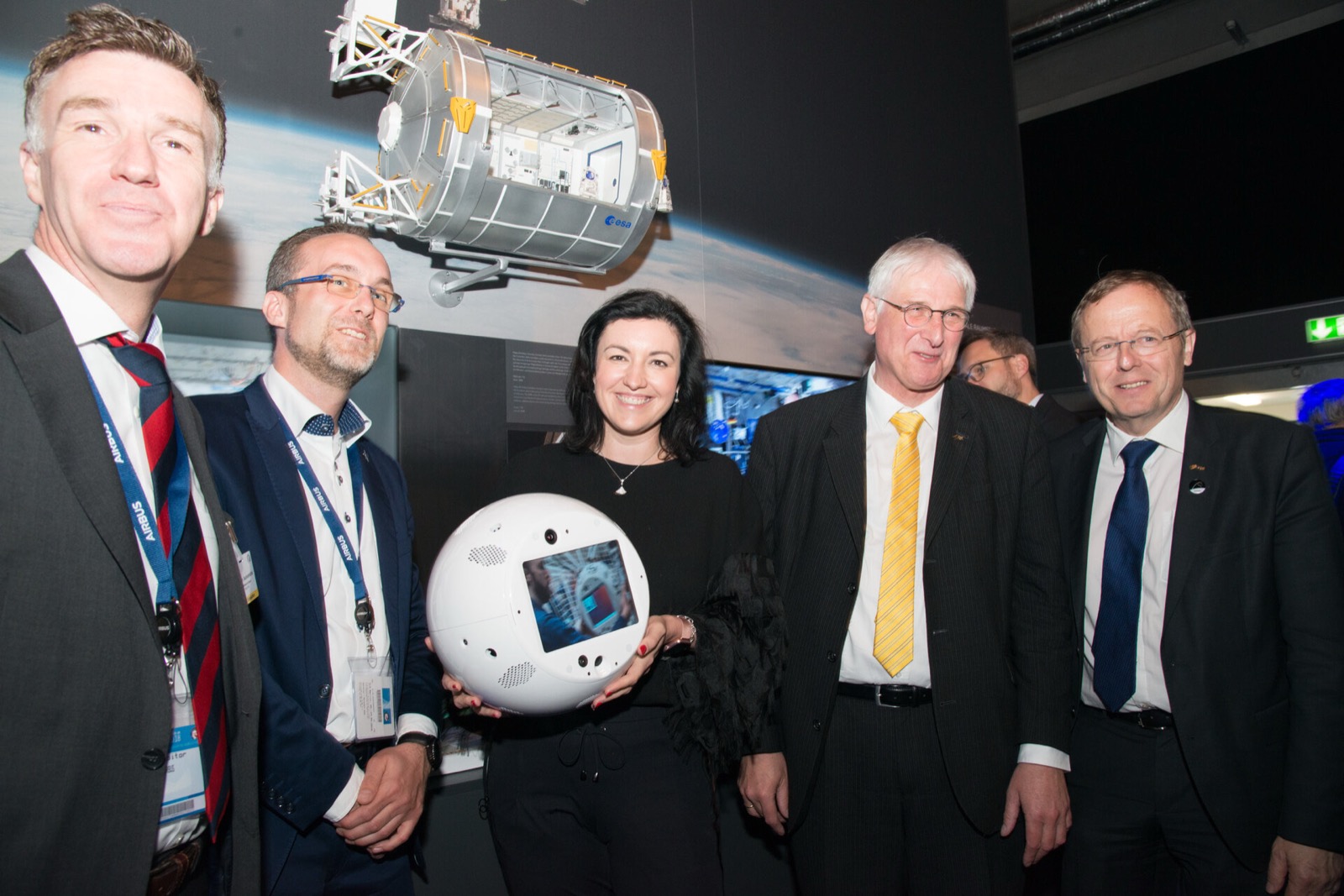
Bär's interest in space predates her ministry. In 2018, then Minister of State for Digitalisation at the Federal Chancellery, she visited the Space Pavilion at the ILA Berlin Air and Space Show. The photograph from that visit shows her holding a model of CIMON, with ESA's then Director General Jan Wörner beside her.
CIMON (Crew Interactive Mobile Companion) was an AI-supported assistant developed by Airbus and IBM on behalf of the DLR. It flew to the International Space Station in 2018 and worked there with the German ESA astronaut Alexander Gerst. For a politician then responsible for coordinating digital policy, it joined two of her themes: artificial intelligence and space.
Analysis The visit was a ceremonial appearance, not a policy role; space policy then lay with the economics ministry. It is relevant mainly as early evidence of the interest she brought to the portfolio in 2025.
09 — Assessment
A record ESA subscription, the largest of any member state; space concentrated in one ministry; a German astronaut slated for the Moon; and a first orbital launch by a German company.
The space law has not reached cabinet. The research budget as a whole fell in 2026 against 2025, so higher ESA commitments must be financed within tighter limits. And the security framing may shift priorities away from science.
For a profile of the ministry's wider priorities see research policy and the High-Tech Agenda.
Research baseline: 7 October 2026. External links open in a new tab.