Dorothee BärResearch · Technology · Space
Contact

02.01 Government

Parliamentary career: the work behind the seat

Since 2002 Dorothee Bär has sat in the German Bundestag. Election results describe how she got there; this page looks at what she did once inside — the roles she held in the CDU/CSU parliamentary group, the committees she sat on, and the themes that ran through two decades of parliamentary work.

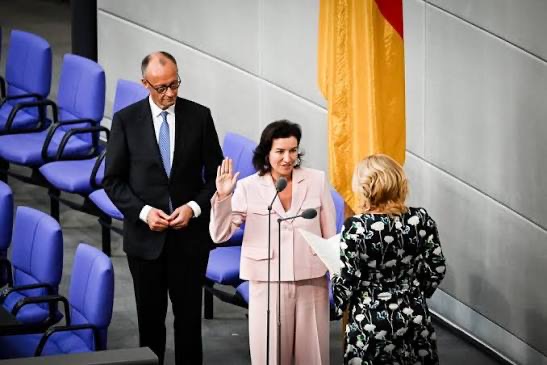
Dorothee Bär taking the oath of office in the Bundestag, with Bundestag President Julia Klöckner and Chancellor Friedrich Merz
Taking the oath of office in the Bundestag, administered by Bundestag President Julia Klöckner, with Chancellor Friedrich Merz, 6 May 2025.

01 — How it works

The machinery of a parliamentary group

Most of the Bundestag's work is done not in the plenary chamber but in parliamentary groups and committees. Understanding Bär's roles requires a short guide to how those bodies are organised.

Parliamentary group (Fraktion)
The organised body of a party's members in the Bundestag. The CDU and CSU form a single joint group, the CDU/CSU-Fraktion, even though they are separate parties; the CSU members also meet as their own regional group within it. The group decides how its members vote, allocates speaking time and committee seats, and employs specialist staff.
Working group and spokesperson
Inside the group, members are organised into working groups that mirror the Bundestag's committees. Each working group is led by a spokesperson (Sprecher or Sprecherin), who coordinates the group's line on that subject, negotiates with the coalition partner's specialists and usually speaks first for the group in plenary debates on the topic.
Deputy group chair
The group chair is supported by several deputy chairs (stellvertretende Fraktionsvorsitzende), each responsible for a cluster of policy areas. A deputy chair oversees the working groups in that cluster, sits in the group's executive and helps set the political line before it reaches the full group. In opposition, a deputy chair is among the most senior figures shaping the group's challenge to the government.
Committee: full and substitute member
Bundestag committees examine bills and scrutinise ministries in detail. Each group fills its seats with full members and an equal number of substitute (deputy) members, who may attend, speak and vote in place of an absent full member. Substitute membership lets senior members keep a formal foothold in several fields.
Parliamentary State Secretary
A member of the Bundestag appointed to support a federal minister, representing the ministry in parliament, in the Bundesrat and in public. Parliamentary state secretaries routinely answer MPs' questions on behalf of their ministry.
Government question time
In the Regierungsbefragung, members of the federal government answer MPs' questions in the plenary, usually after a short opening statement on a current topic.

02 — Roles held

Two decades, five kinds of role

The table follows the official Bundestag and government biographies. Where a detail appears only in Wikipedia, it is marked as such.

Parliamentary and government roles, 2002–2026
PeriodRoleFieldBasis
2002–Member of the Bundestag (CSU); directly elected for Bad Kissingen since 2009Constituency and plenaryBundestag
2005–2009Member of the Foreign Affairs CommitteeForeign policyWikipedia (English) only
2009–2013CDU/CSU group spokesperson for family, seniors, women and youth; sat on the family committee and the culture and media committeeFamily, youth, culture, mediaBundestag; committees per Wikipedia
2013–2018Parliamentary State Secretary, Federal Ministry of Transport and Digital InfrastructureTransport, broadband, logisticsBundestag, Bundesregierung
2018–2021Minister of State to the Federal Chancellor and Commissioner for DigitalisationDigital policyBundestag, Bundesregierung
2021–2025Deputy chair of the CDU/CSU group, responsible for family and culture (including women, youth, seniors and media); substitute member of the Digital, Family and Culture & Media committeesFamily, culture, media, digitalBundestag, Bundesregierung
2025–Federal Minister of Research, Technology and Space, answering to the BundestagResearch, technology, spaceBundesregierung

Analysis  The pattern alternates between the parliamentary group and the executive. In 2009–2013 and again in 2021–2025 her base was the group, with family and culture at the centre. In between, and again since 2025, she held government office, where the Bundestag became the place she was held to account rather than the place she worked from. Her earliest committee seat, on foreign affairs, is reported only by Wikipedia and is not part of the official biographies; it left no lasting thematic mark that the record shows.

03 — By theme

Nine themes across the record

The same subjects recur in different roles. Each entry names the role through which Bär dealt with the theme in parliament and links to a fuller account.

T·01

Family

Her first major parliamentary portfolio. As spokesperson she defended the CSU's contested childcare benefit, the Betreuungsgeld, in the plenary debate of 9 November 2012 as part of what she called a „wunderbares Gesamtpaket“ (“wonderful overall package”) with daycare expansion.

Spokesperson 2009–13 · deputy chair 2021–25

Family & youth

T·02

Youth

Part of the same working group in 2009–2013 and of her cluster as deputy chair from 2021. Her interest in games and e-sports gave the subject an unusual angle for a family politician.

Spokesperson 2009–13 · deputy chair 2021–25

Family & youth

T·03

Digital

Not a formal parliamentary portfolio until the 20th electoral term, when she was a substitute member of the Digital Committee. Her digital profile was built in the CSU's net-policy association and in government.

Substitute member 2021–25

Digitalisation

T·04

Transport

As Parliamentary State Secretary from 2013 to 2018 she represented the transport and digital infrastructure ministry in parliament, alongside her role as the government's coordinator for freight transport and logistics.

Government 2013–18

Transport

T·05

Technology

Since 2025 the High-Tech Agenda Germany has been the core of her ministerial agenda before the Bundestag: six key technologies, roadmaps and flagship goals.

Minister since 2025

Technology policy

T·06

Research

As minister she presents her plans to the Bundestag's research committee and defends the research budget, Einzelplan 30, in the plenary.

Minister since 2025

Research policy

T·07

Culture

A committee seat on culture and media in 2009–2013 according to Wikipedia; from 2021 culture was formally part of her responsibilities as deputy group chair and she was a substitute member of the committee.

Committee · deputy chair 2021–25

Culture & media

T·08

Media

Grouped with culture in her cluster as deputy chair. For Bär, media policy and digital policy have long overlapped, from platforms to games.

Deputy chair 2021–25

Culture & media

T·09

Government modernisation

Mostly an executive theme: as digitalisation commissioner she coordinated, but did not own, the projects for a digital administration. In parliament it surfaced through debates about the digital state.

Government 2018–21

Government modernisation

04 — Opposition years

Deputy group chair, 2021–2025

After the 2021 election the CDU/CSU went into opposition for the first time since 2005, and Bär left the Chancellery. In December 2021 she became one of the group's deputy chairs, responsible for family and culture, a cluster that took in women, youth, seniors and media.

The role was different from her spokesperson years. A spokesperson argues the detail of one field; a deputy chair coordinates several working groups, sits in the leadership that decides the group's line, and in opposition helps decide which government plans to attack and how. Her substitute seats on the Digital, Family and Culture & Media committees in the 20th electoral term gave her a formal presence in each of her fields.

Analysis  The cluster returned her to the subjects of her first parliamentary decade rather than to digital policy, which was not part of her cluster. That is one reason the move to research, technology and space in 2025 came as a change of field rather than the end point of a long specialisation.

05 — Earlier

Spokesperson, 2009–2013

From 2009, the year she first won the Bad Kissingen constituency directly, Bär was the CDU/CSU group's spokesperson for family, seniors, women and youth. The coalition with the FDP was then in government, and the spokesperson's job was to carry government family policy through parliament and to hold the CSU's own priorities within it.

The defining debate of the period was the Betreuungsgeld, a monthly payment for parents who did not use publicly funded daycare for children under three. It was a CSU project, opposed by the opposition parties and contested within the coalition. Bär defended it in the plenary on 9 November 2012, arguing for parents' freedom of choice; the bill passed by 310 votes to 282. The Federal Constitutional Court struck the federal law down in July 2015 because the federal level lacked the legislative competence.

In the same period she was also the CSU's deputy secretary general (2009–2013), which tied her parliamentary work closely to the party's campaigning.

06 — On the government bench

Answering to parliament as minister

Since May 2025 the relationship has been reversed. As Federal Minister of Research, Technology and Space, Bär defends her budget and her programme to the Bundestag and answers its questions.

  1. 6 May 2025

    Oath of office

    Sworn in before the Bundestag as a member of the Merz cabinet.

  2. 26 Sep 2025

    First reading, 2026 budget

    Presents the research budget and calls the High-Tech Agenda her clearest political signature.

  3. 8 Oct 2025

    Government question time

    According to the Bundestag's summary, she said €2 billion would go into fusion research by 2029 so that the world's first fusion power plant could be built in Germany.

  4. 28 Nov 2025

    Second reading, 2026 budget

    The core budget of €21.82 billion is adopted, €0.58 billion less than in 2025.

  5. 20 May 2026

    Roadmaps to the research committee

    Presents the first six technology roadmaps — AI, microelectronics, biotechnology, fusion, batteries and quantum — before a six-week public consultation.

„Eine noch klarere Handschrift als die Hightech-Agenda kann es nicht geben“

“There could be no clearer signature than the High-Tech Agenda”
Documented statement Bundestag, first reading of the 2026 budget, 26 September 2025, bundestag.de

„Raumfahrt ist kein Selbstzweck, sondern es geht dabei um Wirtschaft, Sicherheit und Souveränität.“

“Space is not an end in itself; it is about the economy, security and sovereignty.”
Documented statement Bundestag budget debate, 28 November 2025, bundestag.de

Criticism  In the 2026 budget process, Green MPs including research spokesperson Ayse Asar voiced concern that scientific selection procedures could be bypassed and money concentrated in Bavaria, while Linke MP Sonja Lemke criticised spending blocks on construction and transfer programmes, as reported by Forschung & Lehre.

07 — Significance

What the parliamentary record shows

Bär's parliamentary career is less a single specialism than a sequence of mandates, each defined by the group or the government that gave it.

Read by theme, the record has two centres of gravity. Family, youth, culture and media were her parliamentary home in both of her periods in the group's front line. Digital policy, transport and now research and technology came to her primarily through executive office, where her task in parliament was to explain and defend the government's course.

Analysis  This matters for how her current role is judged. One reading stresses more than two decades of parliamentary experience, including years in the group leadership, which is useful to a minister who must win budgets and majorities. Another stresses that, on the record of her committee seats and group roles, she came to research policy from other fields. Both readings are compatible with the facts. The more detailed constituency and election history is on the Bundestag career page; the full chronology is on the timeline.
Sources

Research baseline: 7 October 2026. External links open in a new tab.

  1. Deutscher Bundestag, biography of Dorothee Bär (21st electoral term). bundestag.de
  2. Deutscher Bundestag, biography of Dorothee Bär (19th electoral term, archive). bundestag.de
  3. Deutscher Bundestag, biography of Dorothee Bär (18th electoral term, archive). bundestag.de
  4. Bundesregierung, curriculum vitae of Dorothee Bär. bundesregierung.de
  5. Wikipedia (English), Dorothee Bär — committee membership 2005–2009. en.wikipedia.org
  6. Wikipedia (German), Dorothee Bär. de.wikipedia.org
  7. Deutscher Bundestag, Betreuungsgeld debate, 9 November 2012. bundestag.de
  8. Deutscher Bundestag, first reading of the 2026 research budget, 26 September 2025. bundestag.de
  9. Deutscher Bundestag, government question time, 8 October 2025. bundestag.de
  10. Deutscher Bundestag, second reading of the 2026 research budget, 28 November 2025. bundestag.de
  11. Deutscher Bundestag, hib 419/2026 on the technology roadmaps. bundestag.de
  12. Forschung & Lehre, on the 2026 BMFTR budget and opposition criticism. forschung-und-lehre.de