Dorothee BärResearch · Technology · Space
Contact

02.02 Government

Transport and digital infrastructure, 2013–2018

Bär's first government office was as Parliamentary State Secretary in a new ministry that put roads, rail, waterways and aviation together with broadband. It was a junior post in a ministry led by her CSU colleague Alexander Dobrindt — and this page is careful to separate what was hers from what was the ministry's.

01 — The ministry

A transport ministry that also owned the cables

When the third Merkel government took office in December 2013, the old Federal Ministry of Transport, Building and Urban Development was recast as the Federal Ministry of Transport and Digital Infrastructure (BMVI).

The new name was the message. Building and urban development moved out; responsibility for digital infrastructure — above all the expansion of broadband — moved in. The ministry was to treat fibre-optic cables and mobile networks as infrastructure in the same sense as motorways and railway lines, with planning, funding and federal programmes to match.

Alexander Dobrindt, who until then had been the CSU's secretary general — with Bär as one of his deputies in the party — became minister. Bär was appointed one of his parliamentary state secretaries. In that capacity she supported the minister, represented the ministry in the Bundestag and in public, and took on specific areas of work. A parliamentary state secretary is a politician, not a civil servant: she does not run the ministry's departments, which report through the permanent state secretaries.

The ministry's most contested project of the period, the infrastructure charge for cars (Pkw-Maut), was Dobrindt's own; the European Court of Justice ruled it incompatible with EU law in 2019. The record does not document a particular role for Bär in it, and this page does not assign her one.

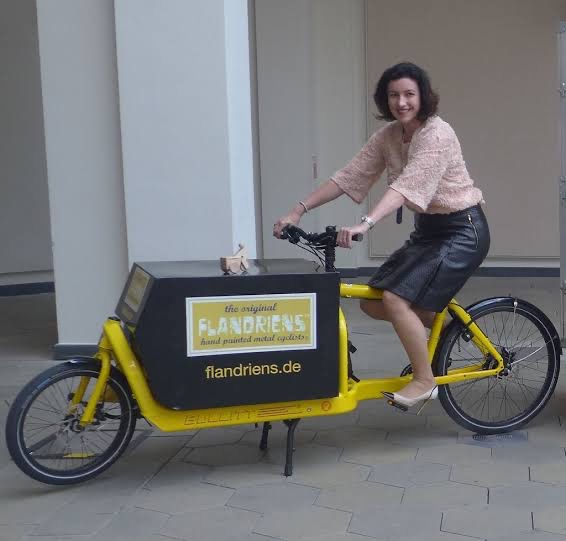
Dorothee Bär riding a yellow electric cargo bike
Dorothee Bär riding a yellow electric cargo bike. The date of the photograph is not documented.

02 — Attribution

Hers, or the ministry's?

Junior ministers often appear at launches they did not design. The table sorts the main themes of the period by what the sources actually show.

What the sources attribute to Bär personally
ThemeWhat happenedAttribution
Freight transport and logisticsAppointed the federal government's coordinator for freight transport and logistics, the industry's point of contact in government, 2014–2018Her office
Broadband fundingHanded over 62 funding notices under the federal broadband programme in July 2016Her documented act within a ministry programme
Drones and railSigned a declaration of intent with Deutsche Bahn on monitoring rail infrastructure with dronesHer signature on behalf of the ministry
Digital Test Field A9Set up in 2015 on about 140 km of motorway between Munich and Nuremberg, with the car industry association VDA, Bitkom and BavariaMinistry level; her personal role unverified
Automated driving lawRoad Traffic Act amended in 2017 to permit highly and fully automated driving functionsMinistry and Bundestag
Ethics commission2017 ethics commission on automated and connected driving, chaired by former constitutional judge Udo Di FabioMinistry level

03 — Case files

Five threads from the transport years

CASE 01 · 2014–2018

Coordinator for freight transport and logistics

The one role in this period that was hers by name.

What it was

The federal government appoints a coordinator to act as the logistics industry's contact person in government: hauliers, freight forwarders, ports, rail freight and parcel services. The trade press reported her appointment as the industry's new point of contact.

Why it mattered

Germany sits at the centre of European freight flows. Questions such as driver shortages, rail freight capacity, digital freight documents and city logistics cut across ministries; a coordinator can bring them to the table.

Limits

A coordinator has no budget or legislative powers of her own. The sources document the appointment; they do not attribute specific measures to her, and none are claimed here.

CASE 02 · July 2016

Broadband funding notices

The new ministry's flagship digital task was closing gaps in fast internet coverage, especially in rural areas.

Documented

According to the federal broadband office's newsletter of August 2016, Bär handed over 62 funding notices under the federal broadband programme in July 2016.

Context

Under the programme the federal government co-financed network expansion where private operators would not build on commercial terms, with municipalities and counties applying for funds.

Assessment

Analysis Handing over notices is a visible act within a ministry programme, not its design. Slow broadband remained a political sore point; it was the subject of the question that led to her “flying taxi” answer in March 2018.

CASE 03 · From 2015

Digital Test Field A9

A stretch of motorway turned into a real-world laboratory for connected and automated driving.

What it was

On roughly 140 km of the A9 between Munich and Nuremberg, the ministry, the VDA, Bitkom and the Free State of Bavaria created a test bed where vehicles could communicate with infrastructure and with each other, documented by the Federal Highway Research Institute.

Why it mattered

Automated driving needs testing in real traffic, with sensors, digital maps and data links. The test field gave manufacturers and researchers a legal and technical setting for that.

Attribution

A ministry-level initiative under Dobrindt. Bär's personal responsibility for it is not verified.

CASE 04 · 2017

Automated driving: the law and the ethics commission

Germany was among the first countries to adapt its road traffic law to automated driving.

The law

The 2017 amendment to the Road Traffic Act allowed vehicles with highly and fully automated driving functions on public roads, while the driver remained responsible for taking back control when required.

The ethics

An ethics commission chaired by Udo Di Fabio addressed questions such as how automated systems should behave in unavoidable accidents and how responsibility and data should be handled.

Attribution

Both were ministry-level projects, and the law was passed by the Bundestag. They are context for the ministry Bär served in, not her personal achievements.

CASE 05 · 2010s

Drones over the railway

An early example of unmanned aircraft being used for infrastructure maintenance.

Documented

Bär signed a declaration of intent with Deutsche Bahn on using drones to monitor rail infrastructure, as reported by the specialist outlet Unmanned Airspace.

Context

Drones can inspect tracks, bridges and overhead lines faster than ground crews, but raise questions of airspace rules, safety and privacy that the ministry was beginning to regulate.

Thread

Since 2025 her research ministry holds responsibility for funding U-space and Advanced Air Mobility, moved from the transport ministry by the organisational decree of 6 May 2025.

Explainer

What “highly” and “fully” automated mean

The 2017 change to the Road Traffic Act used terms that come from a widely used classification of driving automation. The distinctions matter because they decide who is responsible when something goes wrong.

Assisted and partial automation
Systems such as adaptive cruise control or lane-keeping support the driver, who must monitor the road at all times.
Highly automated
The system drives itself in defined situations, for example on a motorway, and the driver may turn away from the road, but must be able to take back control when the system asks.
Fully automated
The system handles the entire driving task within its defined use case without a driver needing to intervene.
Autonomous
Driving without any driver, in all situations. This was not what the 2017 law permitted.

Aside

On the government bench

As a parliamentary state secretary Bär sat on the government bench during plenary debates. On 12 September 2014, during a budget debate, she did so wearing a dirndl. The Green MP Sylvia Kotting-Uhl wrote on Twitter that this was fine in Bavaria but backward („rückständig“) elsewhere; Bär replied with a photograph of the Green politician Claudia Roth in a dirndl. The press dubbed the exchange “Dirndlgate”.

Analysis  The episode had no bearing on transport policy. It is recorded here because it shows an early example of the social-media combativeness and regional self-presentation that became part of Bär's public profile, and that later shaped how her digital-policy statements were received.

04 — Questions

Reading the record carefully

Four questions that come up when the transport years are cited in support of, or against, Bär's later roles.

Q1Was she responsible for broadband expansion?

No, not in the sense of owning it. Broadband was a ministry responsibility under Minister Dobrindt. Bär is documented handing over funding notices and, later, as digital commissioner, coordinating digital policy across government. The slow pace of broadband expansion was a criticism of the government as a whole, which she nonetheless often had to answer in public.

Q2Did she shape automated-driving policy?

The available sources do not show a personal role. The A9 test field, the 2017 change to the Road Traffic Act and the ethics commission were ministry-level. It is fair to say she served in the ministry that took these steps; it is not supported to say she led them.

Q3What did the logistics role involve?

It made her the government's named contact for the freight and logistics industry from 2014 to 2018. That is a role of access and advocacy within government. The sources consulted do not list specific programmes resulting from it.

Q4How does this connect to her current ministry?

More than might be expected. Satellite navigation, Earth observation, U-space and Advanced Air Mobility funding moved from the transport ministry to the research ministry in 2025; technologies for climate-neutral mobility are one of the six fields of the High-Tech Agenda. See technology policy and space policy.

05 — Significance

An apprenticeship in infrastructure politics

The transport years gave Bär a vocabulary, not a portfolio: broadband, connected vehicles, drones and logistics.

Analysis  As a parliamentary state secretary, Bär's influence was bounded by the minister and by the ministry's own administration. What the period did was place her inside the first federal ministry to treat digital networks as infrastructure, at a time when connected and automated driving moved from research topic to legislation.

That experience was the background to her appointment as Commissioner for Digitalisation in March 2018. It also means that some of the criticism later directed at her — about slow broadband in particular — concerned a field in which she had served, though not as the decision-maker.

Seen from 2026, the most direct continuity runs through aviation and space. Drone and air-mobility questions that began as transport issues now sit, as research and funding questions, in the ministry she leads. Whether that continuity produces results is a question for the research ministry's record, not for the transport years.

Sources

Research baseline: 7 October 2026. External links open in a new tab.

  1. Deutscher Bundestag, biography of Dorothee Bär (21st electoral term). bundestag.de
  2. Bundesregierung, curriculum vitae of Dorothee Bär. bundesregierung.de
  3. Wikipedia (English), Dorothee Bär — exact dates of office. en.wikipedia.org
  4. eurotransport.de, Bär becomes the new logistics coordinator. eurotransport.de
  5. VerkehrsRundschau, Dorothee Bär looks after logistics. verkehrsrundschau.de
  6. Breitbandbüro des Bundes, newsletter August 2016 (62 funding notices). gigabitbuero.de
  7. Federal Highway Research Institute (BASt), Digital Test Field Motorway. bast.de
  8. Unmanned Airspace, Deutsche Bahn and the transport ministry on drone monitoring of rail infrastructure. unmannedairspace.info
  9. Organisationserlass of the Federal Chancellor, 6 May 2025 (BGBl. 2025 I Nr. 131). gesetze-im-internet.de
  10. Stuttgarter Zeitung, on the 'Dirndlgate' exchange of September 2014. stuttgarter-zeitung.de