Dorothee Bär has been in the Bundestag for more than two decades and in her current office for less than a year and a half. Any verdict on her legacy is premature. This page sets out what can already be said, where reasonable people disagree, and which developments will decide the question.
AnalysisThird-party assessmentVerified fact
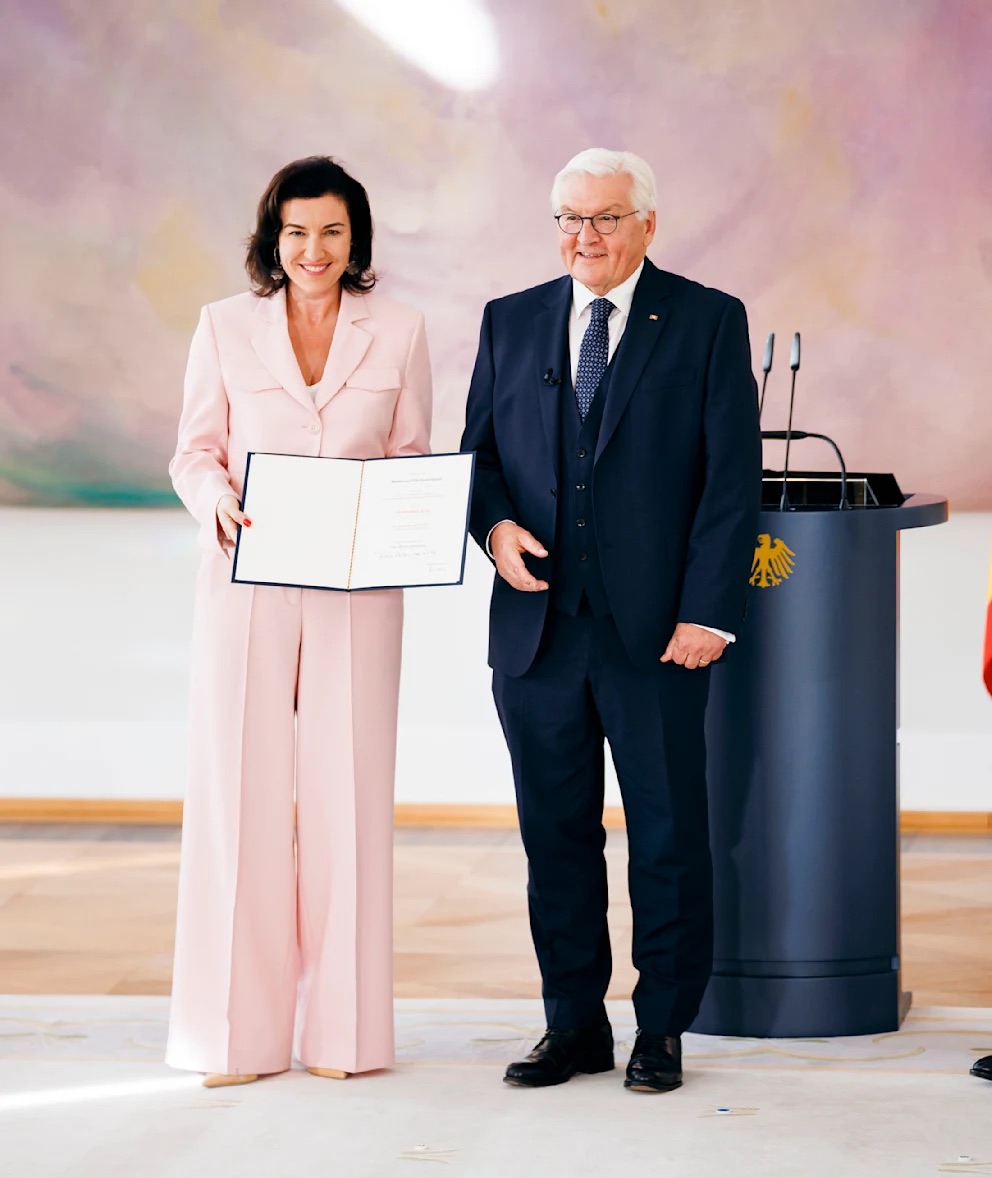
Holding her certificate of appointment beside Federal President Frank-Walter Steinmeier at Bellevue Palace, May 2025.
01Why the verdict is open
Political legacies are usually judged after a career ends, and often long after. Dorothee Bär, born in 1978, is a serving Federal Minister. The research for this page closes on 7 October 2026, seventeen months into her term at the Federal Ministry of Research, Technology and Space (BMFTR). The most important programmes she now leads, from the High-Tech Agenda to the Fusion Action Plan, set targets for 2028, 2029, 2030 and beyond.
That makes this an assessment of significance rather than a balance sheet. It distinguishes three things throughout: what is documented, what supporters and critics argue, and what this site concludes. The labels make the difference visible. Where the page offers its own interpretation, it says so.
It also avoids a common error: crediting or blaming a politician for decisions that belonged to others. The Online Access Act was the Interior Ministry's programme; the Excellence Strategy decision of May 2025 was a joint federal and state process; the creation of the BMFTR was a decision of the Chancellor's organisational decree. Her legacy has to be measured against what her offices actually allowed her to do.
02Political contribution: a career built inside the CSU
Verified factAnalysis
Few federal politicians have spent as much of their life inside one party's structures. She joined the Junge Union in 1992 and the CSU in 1994, has sat on the CSU party executive since 2001, chaired the Bavarian RCDS student association, served as deputy chair of the Junge Union in Bavaria and nationally, and was the CSU's deputy secretary general from 2009 to 2013. Today she is one of the party's deputy chairs and its county chair in Haßberge, re-elected in July 2025.
Her political positions have been those of a mainstream CSU politician with a distinctive emphasis on modernisation. In family policy she defended the Betreuungsgeld in 2012 as a matter of parents' freedom of choice; in 2010 she backed a binding women's quota within the CSU at a time when women made up around 18 per cent of the membership.
A sympathetic reading
She has helped the CSU present a younger, more digital and more female face without breaking with its conservative core. The quota and her net-policy work through CSUnet are examples of modernisation from within.
A sceptical reading
A career spent almost entirely in party and parliament may explain a style that critics see as stronger on communication than on administration. Her move into research policy in 2025 came with the formation of the Merz cabinet, not from a long specialisation in science.
03Parliamentary career: two decades and a strong mandate
Verified fact
She entered the Bundestag in 2002 via the CSU's state list at the age of 24, and has held the Bad Kissingen constituency directly since 2009. Her first-vote shares tell a story of their own: 53.7 per cent in 2009, 57.9 in 2013, 51.1 in 2017, 39.1 in 2021, and 50.5 in 2025, when the Bundestag named her the “Erststimmenkönigin”, the candidate with the highest first-vote share in the country.
Her parliamentary portfolio has centred on family, women, youth, culture and media: as the CDU/CSU group's spokesperson from 2009 to 2013, and as deputy group chair for family and culture from December 2021 to 2025, when the Union was in opposition.
What the record supports
Durable local support in a Franconian constituency, recovered strongly after the Union's weak 2021 result, and a steady rise through the group's leadership.
What it does not settle
Constituency results reflect party strength as much as personal standing, and her parliamentary specialism lay in social and cultural policy rather than in the science portfolio she now holds.
04Digitalisation: the role that defined her public image
Verified factCriticismAnalysis
From March 2018 to December 2021 she was Minister of State in the Federal Chancellery and the government's first Commissioner for Digitalisation. She worked with the Digital Council of outside experts, coordinated the round of state secretaries in the Digital Cabinet, and communicated the implementation strategy “Digitalisierung gestalten”. In June 2020 she opened the press conference presenting the Corona-Warn-App.
She also had no ministry and no ministry budget of her own, a point netzpolitik.org made as soon as her appointment was announced. The flying-taxi interview and her remark about “data protection like in the 18th century”, both from March 2018, shaped her image before she took office. The announced “Bundeszentrale für digitale Aufklärung” remained, according to netzpolitik.org in 2021, a €20,000 feasibility study with a handful of events.
Supporters argue
She gave digital policy a visible place at the centre of government for the first time and argued, as early as 2020, for a dedicated digital ministry. The creation of the Federal Ministry for Digital and State Modernisation in 2025 can be read as vindication of that argument.
Critics argue
The post produced more announcements than results, and her own remarks distracted from the basics of connectivity and administration. Germany's middling DESI rankings during her term are cited as evidence.
Analysis The fairest reading may be that the commissioner post showed what a coordinating role without resources cannot achieve, and that her legacy in this field is as much institutional, through the case for a digital ministry, as it is programmatic. See Digitalisation and Criticism and controversies.
05Public administration: accountability without control
Verified factThird-party assessment
The Online Access Act of 2017 required 575 administrative services to go online by the end of 2022. In September 2021 the National Regulatory Control Council said the deadline could not be met, and it was missed. Responsibility lay with the Federal Ministry of the Interior and, in implementation, with the Länder and municipalities.
Analysis Her legacy in public administration is therefore indirect. She was the public face of a digital state that did not arrive on schedule, without being its architect. Earlier, at the transport and digital infrastructure ministry from 2013 to 2018, she handed over federal broadband funding notices and served as the government's logistics coordinator, but the ministry's major projects, such as the A9 digital test field, were ministry-level work. See Government modernisation and Transport and infrastructure.
06Research and technology leadership: an agenda with dates attached
Verified factDocumented statementCriticism
Since 6 May 2025 she has led a ministry that combines research funding with technology policy and space. Its centrepiece is the High-Tech Agenda Germany, adopted by the cabinet on 30 July 2025: six key technologies, around €18 billion to 2029, and flagship goals such as at least two error-corrected quantum computers at European top level by 2030 and at least one European AI gigafactory in Germany. In May 2026 she presented the first six technology roadmaps, with dated milestones, for public consultation.
Other initiatives include the Fusion Action Plan, the National Platform for Research Security agreed in December 2025, and the 1000 Köpfe Plus programme for international researchers, which reached 286 approvals in its first year.
„Eine noch klarere Handschrift als die Hightech-Agenda kann es nicht geben“
“There could be no clearer signature than the High-Tech Agenda.”
Documented statement Bundestag, first reading of the 2026 budget, 26 September 2025, Deutscher Bundestag
Supporters argue
The agenda gives German research policy a clear focus on a few strategic technologies, with measurable milestones and a single ministry responsible for research, technology and space.
Critics argue
The Greens' research spokesperson Ayse Asar has said the government talks of roadmaps and dialogue formats but cannot show the actual effect of the money spent. The core budget fell in 2026, and the 3.5 per cent R&D target has been moved to 2030.
07Innovation policy: transfer, games and start-ups
Verified factAnalysis
The 2025 reorganisation brought SPRIND, the Federal Agency for Breakthrough Innovation, and responsibility for games into her ministry. The planned transfer agency DATI was not continued; according to Bundestag papers, the coalition replaced it with an umbrella brand, “Initiative Forschung & Anwendung”. The roadmaps add instruments such as a €100 million “KI-Robotik-Booster” and four “Hightech-Spaces”.
One long-running theme has come to fruition: in September 2025 the cabinet approved charitable status for e-sports, a cause she had championed for years and called a milestone for gaming, youth work and club life.
Analysis Innovation policy is where her long interest in digital culture and her current office meet most directly. Whether the transfer of research into products improves is the question that will matter most to industry, and it cannot yet be answered. See Innovation and Culture and media.
08Space policy: Germany as Europe's largest contributor
Verified factDocumented statement
At the ESA Council at Ministerial Level in Bremen in November 2025, Germany subscribed €5.4 billion, about 23 per cent of the total and the largest single contribution, compared with a previous German subscription of just under €3.5 billion, according to reporting by Spektrum. Analysis Her framing of space as a matter of the economy, security and sovereignty marks a shift in emphasis from science alone.
In September 2026 Isar Aerospace reached orbit from Norway, the first commercial launch provider to do so from continental Europe. That is a milestone for the sector, not an achievement of her ministry. A national space law, whose key points the previous government adopted in 2024, was still in inter-ministerial coordination in July 2026.
Supporters argue
The Bremen subscription and the bundling of space responsibilities in one ministry give Germany more weight in Europe at a time when space is increasingly linked to security.
Sceptics ask
Whether money committed to ESA translates into industrial and strategic returns, and why the legal framework for commercial space activity is still missing.
The CSU has historically had a low share of women in its membership. Bär's backing of a binding quota in 2010, her role as one of the party's deputy chairs and her position as one of its most senior women in federal government make her a reference point in that debate. Critics within and outside the party may disagree about how much the quota has changed, but her place in the argument is documented.
Generational change
She entered the Bundestag at 24 and became a federal minister at 47, having spent most of her adult life in elected office. She belongs to the first generation of German politicians whose careers ran in parallel with the internet, and her early adoption of net policy reflects that.
Franconian representation
Born in Bamberg, based in Haßberge and representing Bad Kissingen, she has made Franconia a visible part of her identity. Bavarian politics is often seen through the lens of Munich and Upper Bavaria; her standing in Lower Franconia, confirmed by the 2025 first-vote result, gives the region a prominent voice in Berlin.
A communicator's style
Her style mixes regional symbolism, from the dirndl in the Bundestag to the cabinet table, with an unusually open embrace of games, social media and pop culture for a CSU politician. In February 2026 the Aachen carnival association awarded her the Orden wider den tierischen Ernst, an honour for humour in public life; in July 2026 she received the Bavarian Order of Merit.
A sympathetic reading
Her accessibility makes research and technology policy visible to audiences that rarely follow it, which matters for a field that depends on public support and on attracting young talent.
A sceptical reading
The same style invites the charge that presentation outruns substance, a charge that has followed her since the flying-taxi interview of 2018 and that her ministry's measurable targets will now test.
10 — Open questions
What to watch
Six tests will shape how this period is judged. Each has a date or a document attached, which means the answers will be public.
Q · 01
Do the roadmaps deliver?
Milestones 2028–2032
The first six roadmaps set targets such as first logical qubits in Germany by 2028, more than half of manufacturing SMEs using AI in core processes by 2029, and a first approval of an mRNA cancer immunotherapy by 2028. Roadmaps for robotics and climate-neutral energy are still to come.
Q · 02
The 2030 quantum goal
Target year 2030
The High-Tech Agenda promises at least two error-corrected quantum computers at European top level by 2030, with quantum advantage to be demonstrated by 2032. These are demanding goals in a field where technical progress is hard to schedule.
The Fusion Action Plan aims for “the world's first fusion power plant in Germany”. Funding is committed to 2029; a working plant lies well beyond any electoral term. Progress will be measured by hubs, infrastructure and private investment along the way.
Key points were adopted in September 2024; in July 2026 the law was still in inter-ministerial coordination, with no cabinet draft found as of October 2026. A legal framework for commercial launches and satellites is a test of the ministry's new space remit.
The core budget fell from €22.4 billion in 2025 to €21.82 billion in 2026, offset by special funds. R&D spending reached 3.17 per cent of GDP in 2024; the 3.5 per cent target now applies to 2030. Ambition and money will have to meet.
The National Platform for Research Security is due to be fully operational in January 2027. Its test is the balance she herself named: securing research while protecting academic freedom.
The first half is political: a long party career and a durable mandate. The second, ministerial, will be judged by results not yet due.
Analysis On the evidence to date, her clearest lasting contributions are political rather than programmatic: two decades of CSU and parliamentary leadership, a prominent role for women in a party where they have been under-represented, and a long-standing insistence that digital policy, games and technology belong at the centre of government. Her digitalisation years left an image she has had to work against, and a structural lesson about coordinating roles without resources.
As research minister she now holds the resources the commissioner post lacked. The High-Tech Agenda, the roadmaps, the Bremen subscription and the Fusion Action Plan are ambitious and dated. If they are met, her significance will rest on them; if they are not, the criticism of 2018 will acquire a new edge. Either way, the verdict belongs to the coming years.