Early years
Bamberg, an exchange year in Illinois, the Abitur and political science in Munich and Berlin. Party involvement begins in 1992, long before graduation.
05.01 Archive
Forty-eight years in thirty entries: a Bamberg childhood and an exchange year in Illinois, the Junge Union and the CSU, the Bundestag from 2002, two government posts under Angela Merkel, and since May 2025 the Federal Ministry of Research, Technology and Space. Filter by era, or read straight through.
01 — Chronology
Dates follow the official biographies of the Bundestag and the Federal Government. Where only a secondary source records a date, the entry says so. Each entry links to the page that tells the story in full.
Milestone Key turning point
Dorothee Bär is born on 19 April 1978 in Bamberg, in the Upper Franconian part of Bavaria. Franconia remains her political base: she later represents the Lower Franconian constituency of Bad Kissingen.
In 1992 she joins the Junge Union, the joint youth organisation of the CDU and CSU, the start of an unbroken career in the party's youth and student organisations.
She joins the Christian Social Union in the district of Haßberge in Lower Franconia, where she later becomes county chair.
After an exchange year in 1995/96 she gains a high school diploma in Grayslake, Illinois, in the United States.
She takes her Abitur at the Franz-Ludwig-Gymnasium in Bamberg and begins studying political science at the Hochschule für Politik in Munich, later continuing at the Otto Suhr Institute of the Freie Universität Berlin, as a Hanns Seidel Foundation scholarship holder. According to German Wikipedia, she also joins the district board of the Junge Union in Lower Franconia.
She is elected to the CSU party executive (Parteivorstand), of which she has been a member ever since. From 2001 to 2003 she chairs the Bavarian branch of the RCDS, the Christian Democratic student association.
She enters the German Bundestag via the CSU's Bavarian state list, aged 24 and, according to Wikipedia, the youngest member of the CSU group.
She serves as deputy state chair of the Bavarian Junge Union from 2003 to 2007.
She graduates as a Diplom-Politologin. After the 2005 federal election she re-enters the Bundestag on 23 November 2005, taking the list seat that Günther Beckstein did not take up.
She becomes deputy federal chair of the Junge Union Deutschland (2008–2012) and is elected to the county council (Kreistag) of Haßberge.
She becomes deputy secretary general of the CSU (2009–2013), alongside Secretary General Alexander Dobrindt. In the federal election she wins the Bad Kissingen constituency directly with 53.7% of first votes, and becomes the CDU/CSU group's spokesperson for family, seniors, women and youth until 2013.
She takes the chair of CSUnet, the CSU's association for internet and net policy; the official biographies give 2010 and 2011 respectively. In October 2010 she also backs a binding women's quota in the CSU, which the party congress adopts that month.
On 9 November 2012 she defends the childcare allowance (Betreuungsgeld) in the Bundestag, arguing for parents' freedom of choice and calling it, together with the expansion of daycare, a “wonderful overall package”. The bill passes by 310 votes to 282. In 2015 the Federal Constitutional Court strikes the federal allowance down for lack of federal competence.
On 17 December 2013 she becomes Parliamentary State Secretary at the new Federal Ministry of Transport and Digital Infrastructure (BMVI) under Alexander Dobrindt, serving until March 2018.
She is appointed Federal Government Coordinator for Freight Transport and Logistics, the government's point of contact for the logistics industry, a role she holds until 2018.
She becomes Minister of State to Chancellor Angela Merkel and the Federal Government's first Commissioner for Digitalisation. The post is based in the Chancellery and has no ministry of its own; the week before, a television remark about flying taxis drew wide mockery.
The government's ten-member Digital Council of outside experts, chaired by Katrin Suder, holds its first meeting. In November the cabinet adopts the implementation strategy “Digitalisierung gestalten”.
She opens the government press conference presenting the federal contact-tracing app for the COVID-19 pandemic.
„Es ist eine App, die uns helfen soll, gemeinsam den Kampf gegen die weltweite Pandemie zu führen“
“It is an app that is meant to help us fight the global pandemic together.” Documented statement
With the Merkel government's term ending on 8 December 2021, she becomes deputy chair of the CDU/CSU parliamentary group in opposition, responsible for family and culture, including women, youth, seniors and media.
In the federal election she wins constituency 247, Bad Kissingen, with 50.5% of first votes, the highest share of any constituency winner in Germany. The Bundestag calls her the “queen of first votes”.
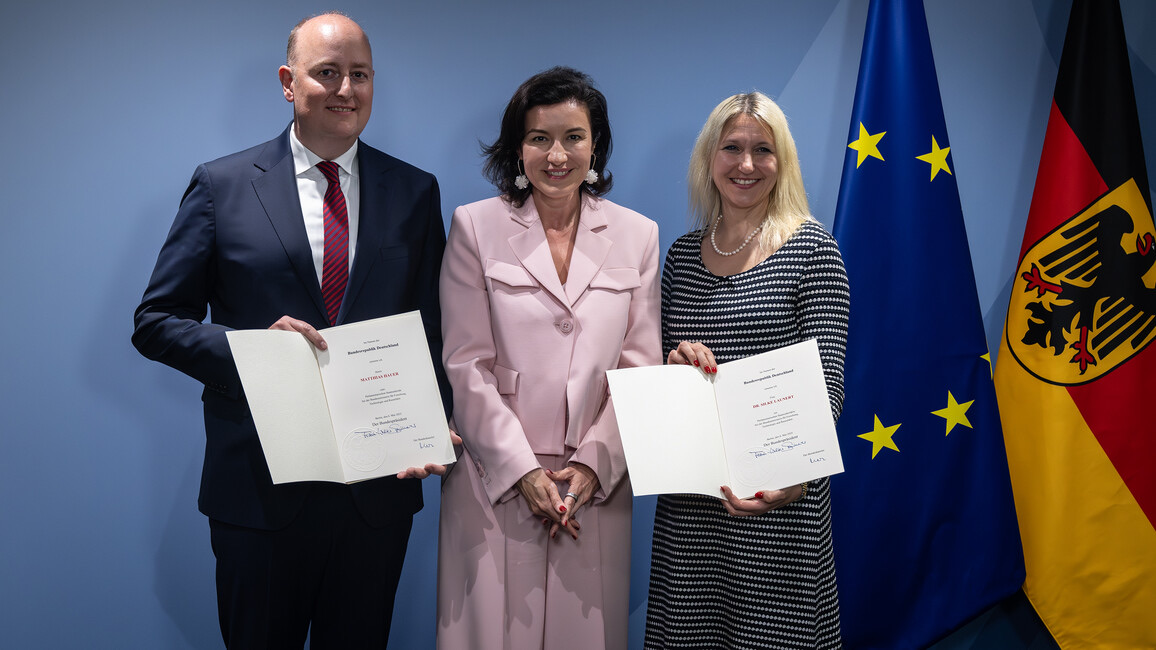
She is sworn in as a member of Friedrich Merz's cabinet. The same day, the Chancellor's organisational decree turns the education and research ministry into the BMFTR, adding space, technology policy and the High-Tech Agenda while moving school and vocational education out.
The cabinet adopts the High-Tech Agenda, built around six key technologies: artificial intelligence, quantum technologies, microelectronics, biotechnology, fusion and climate-neutral energy generation, and climate-neutral mobility.
The cabinet approves charitable (gemeinnützig) status for e-sports as part of the 2025 Tax Amendment Act. Bär, a long-time advocate of games, calls it a milestone for gaming, youth work and club life.
The cabinet adopts the “Aktionsplan Fusion”, with more than €2 billion by 2029 and the stated goal of the world's first fusion power plant in Germany.
Germany subscribes €5.4 billion to the European Space Agency, about 23% of the total, making it the largest contributor.
The federal government, the Länder and the science organisations agree key points for a National Platform for Research Security, led and funded by the BMFTR until 2029 and due to be fully operational in January 2027.
The Aachen carnival association (Aachener Karnevalsverein) awards her its “Order against deadly seriousness”, a carnival honour for humour in public life.
She presents the first six roadmaps of the High-Tech Agenda (AI, microelectronics, biotechnology, fusion, batteries and quantum) to the Bundestag research committee, followed by a six-week public consultation.
She receives the Bayerischer Verdienstorden, the Free State of Bavaria's order of merit.
On its second flight, the Spectrum rocket of the Bavarian company Isar Aerospace reaches orbit from Andøya, Norway, with six payloads: the first commercial launch provider to do so from continental Europe. This is a milestone for the sector, not an achievement of the ministry; it is listed for context.
02 — Five eras
The filters above follow five overlapping eras. Party work and parliamentary work ran side by side for most of her career; the government years were interrupted by four years in opposition.
Bamberg, an exchange year in Illinois, the Abitur and political science in Munich and Berlin. Party involvement begins in 1992, long before graduation.
From the Junge Union and RCDS to the CSU executive, the deputy secretary-generalship and, today, one of the CSU's deputy party chairs and county chair in Haßberge.
A member of the Bundestag since 2002 and directly elected since 2009. Family policy spokesperson, then deputy group chair for family and culture from 2021 to 2025.
Eight years under Angela Merkel: more than four at the transport and digital infrastructure ministry, nearly four as Minister of State and Commissioner for Digitalisation.
Federal Minister for Research, Technology and Space: the High-Tech Agenda, fusion, ESA, research security and the first technology roadmaps.
The official biographies of the Bundestag and the Federal Government are the primary reference. Three entries rest partly on other sources and are marked in the text: the Junge Union district board in Lower Franconia from 1999, her status as the youngest CSU member in 2002, and the exact date of her return to the Bundestag in November 2005, all recorded by Wikipedia. For CSUnet, earlier Bundestag biographies give 2010 and 2011. The 2015 Constitutional Court ruling on the Betreuungsgeld is part of the general public record.
Corrections are welcome via the contact page.
Research baseline: 7 October 2026. External links open in a new tab.